
Recently, while scrolling through Instagram, I came across an artist mixing oil paints on a palette with a palette knife. He had three blobs of pigment: PG7 Phthalocyanine Green, PR122 Quinacridone Magenta, and PW6 White.
He began blending some of the Quinacridone Magenta into Phthalocyanine Green. As he blended them, a pleasing purple emerged. But then, as he added Phthalo Green the blended colour became . . . blue! But I’ve always been told and believed that a primary colour cannot be blended from other pigments. In fact, if you research colour theory, you’ll typically find this; “Red, yellow, and blue are the primary colors used in traditional art and are considered foundational because they cannot be made by mixing other pigments.”
So, given how modern technology has turned us into skeptics often wondering if a video we’re seeing is reality or trickery, I decided to test this myself.
Although I tell artists to not use PG7 Phthalo Green for mixing greens because its garish and difficult to turn into natural-looking green, I have a tube that had been given to me by a manufacturer. Also, being watercolour, I didn’t need the PW6 White as water would do the job just fine.
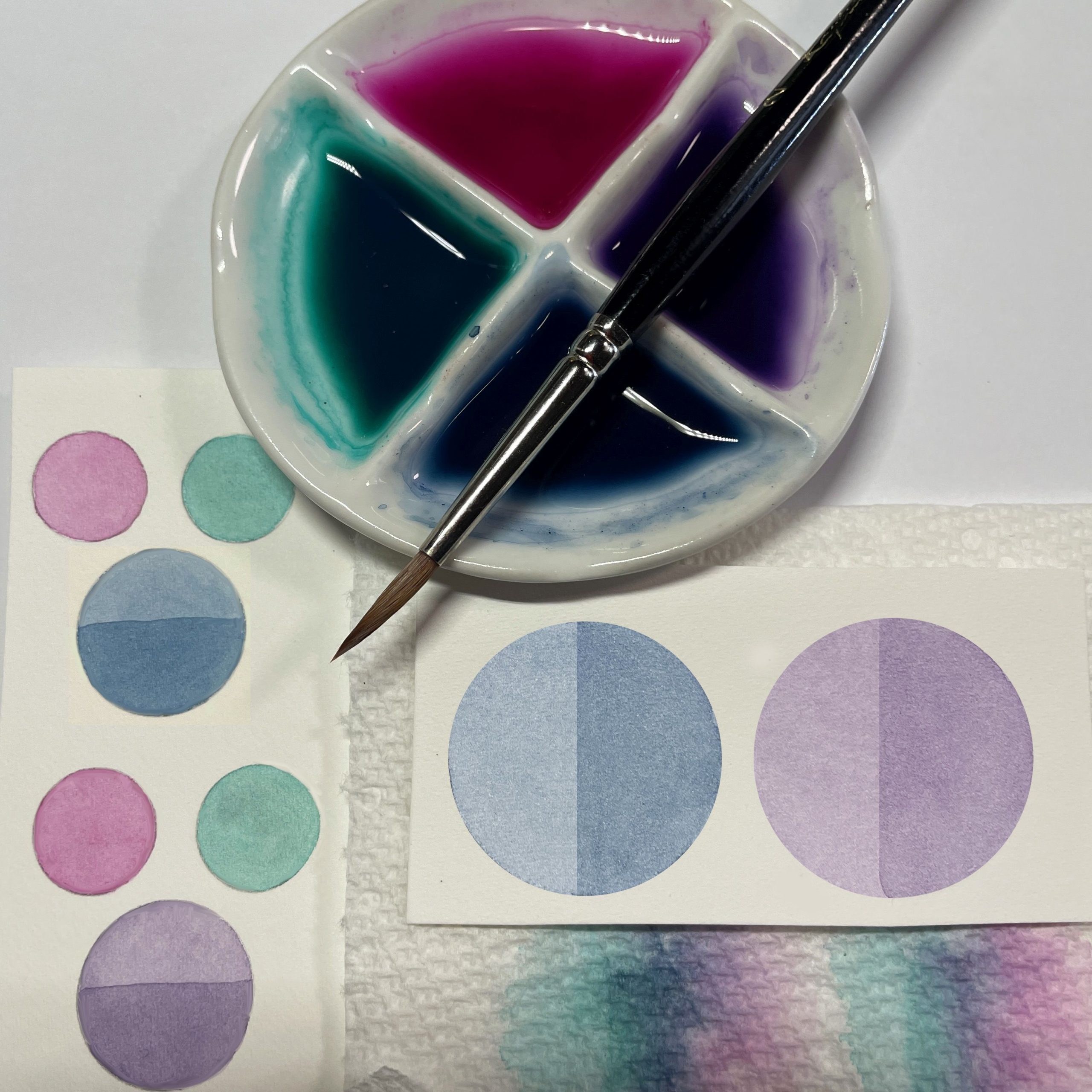
As I blended various ratios of Quinacridone Magenta and Phthalocyanine Green I was astonished to see a purple and then a blue hue emerge. Astonishingly, I’d just mixed a primary colour by using other pigments.
So, what happened here? Quinacridone Magenta had transformed a garish green into two beautiful hues. Somehow the blue bias of each pigment appeared to have combined to make two incredible colours.
This revelation is not necessarily causing me to change my do-not-buy-Phthalo-green recommendation, but if you have it, you can now use it to mix the colours that I did. I think the purple is going to be useful for neutral colour combinations and as a weak blend for reflected light on a number of subjects.
I also think that I’ll be making use of these surprising blends for subjects such as blueberries, eggplants, and grapes.