
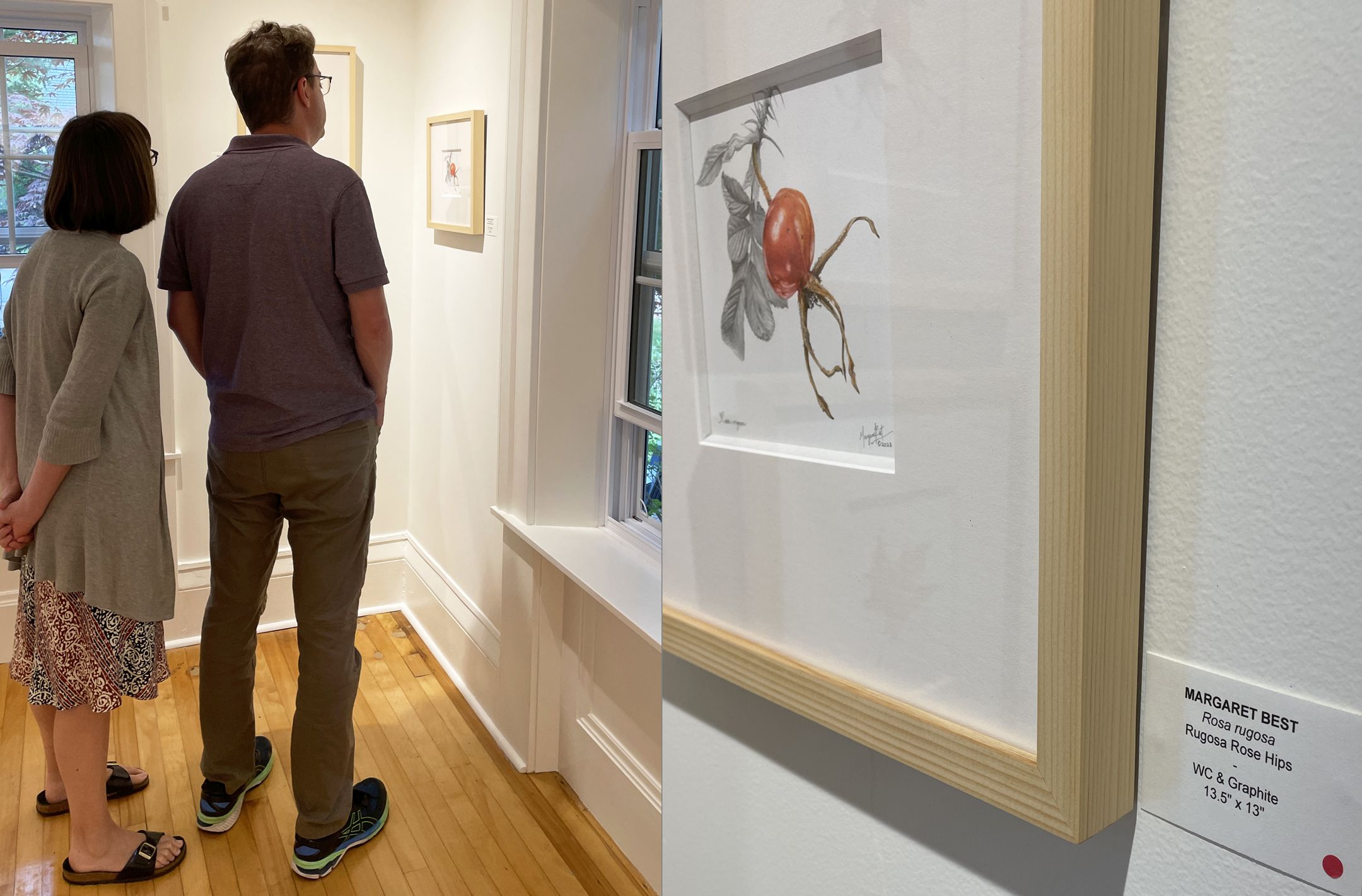
Recently, a fellow botanical artist sent me a quote she found on social media. It’s expressed as a reminder to a potential buyer of art as to what they are really buying.
“When you buy a piece of art from an artist, you are buying hundreds of hours of failures and experimentation.”
I thought that for botanical art, this line carries even more weight than usual. Few genres demand this much invisible labor before a single finished piece is ready to be seen. By way of reminding us of what our work really represents, imagine a seasoned botanical art collector advising a first-time collector who may (as some do) be balking at the price, of what they’re really buying . . .
“Most of us encounter a finished botanical art piece at its endpoint: a precise, luminous rendering of a peony or a fern, every vein or petal accounted for. What we don’t see is the artist’s years of learning to actually look at a plant — not just its outline, but the way its structure changes as it grows, wilts, or turns toward light. We don’t see the dozen studies of a single leaf, done over and over until the artist understood not just its shape but its logic. That invisible labor is the actual product, even if the paper is what changes hands.
Think about what ‘hundreds of hours’ means in this context. Botanical art sits at the intersection of scientific accuracy and artistic sensibility, and both take years to develop. It’s the time spent learning plant morphology well enough to render it correctly from any angle. It’s also time spent testing how a wash of watercolour behaves on a petal versus a stem, how to suggest translucency without losing precision, how to capture a specimen that may wilt or change colour before the painting is finished. Every failed study taught the artist something a textbook couldn’t. The piece in front of you is the surviving result of a much longer, mostly unseen, yet determined process.
This is why comparing the price of botanical art to the cost of paper and pigment misses the point entirely. What you’re really paying for is the decades of careful in-depth, personal connections with plants that allows a botanical artist to translate a living, changing organism into something both scientifically credible and quietly beautiful. You’re not paying for paint. You’re paying for a sophisticated and well-trained eye.
The hidden content and value also change how we might look at the work. Instead of just admiring the finished bloom, we might wonder how many specimens wilted before the artist finished the study, or how many attempts it took to get the colour right. When you buy a piece of botanical art, you’re not buying a picture of a plant. You’re buying someone’s patience, sharpened through hundreds of hours of trying to truly capture the content that evokes a powerful connection with it.”